If you rent an apartment in NYC, one 30-second search could be worth thousands of dollars.
Possibly much more.
Here's the issue: some NYC apartments are rent stabilized, which means landlords can't just charge whatever they want. They have to follow specific rules on rent increases, lease renewals, and tenant protections.
Landlords may conveniently forget to list a unit as being rent stabilized, and even more conveniently, will forget to price it as such. If you had this type of conveniently forgetful landlord, you may not know. And if you don't know, you may just keep paying. The city tries to go after landlords who do this, but you may have to take matters into your own hands.
The stakes can get big quickly. A few hundred dollars a month in overcharges can turn into thousands of dollars a year. In some cases, tenants can recover overcharges, interest, and up to 3x damages.
I am not a lawyer. This is not legal advice. This is just arithmetic.
The hard part is figuring out whether your apartment might be stabilized in the first place.
The city does publish clues. This is good.
The clues are spread across government websites, borough-level documents, building-level lists, and PDFs that appear to have structure when you look at them, but are actually not easily searchable. This is less good.
The documents are only technically searchable, in the same way a junk drawer is technically organized because all the batteries are somewhere inside it.
You can't just search "123 40th Street" and get a clean answer. Addresses are split apart, normalized inconsistently, and buried across hundreds of pages. So you end up searching for "123" or "40" and then scrolling through tens of thousands of unrelated listings, hoping that your apartment reveals itself.
This is exactly the kind of problem we spend a lot of time thinking about at sieve: the answer exists, but it is trapped in websites, PDFs, and layouts that are hostile to the actual question a person wants to ask.
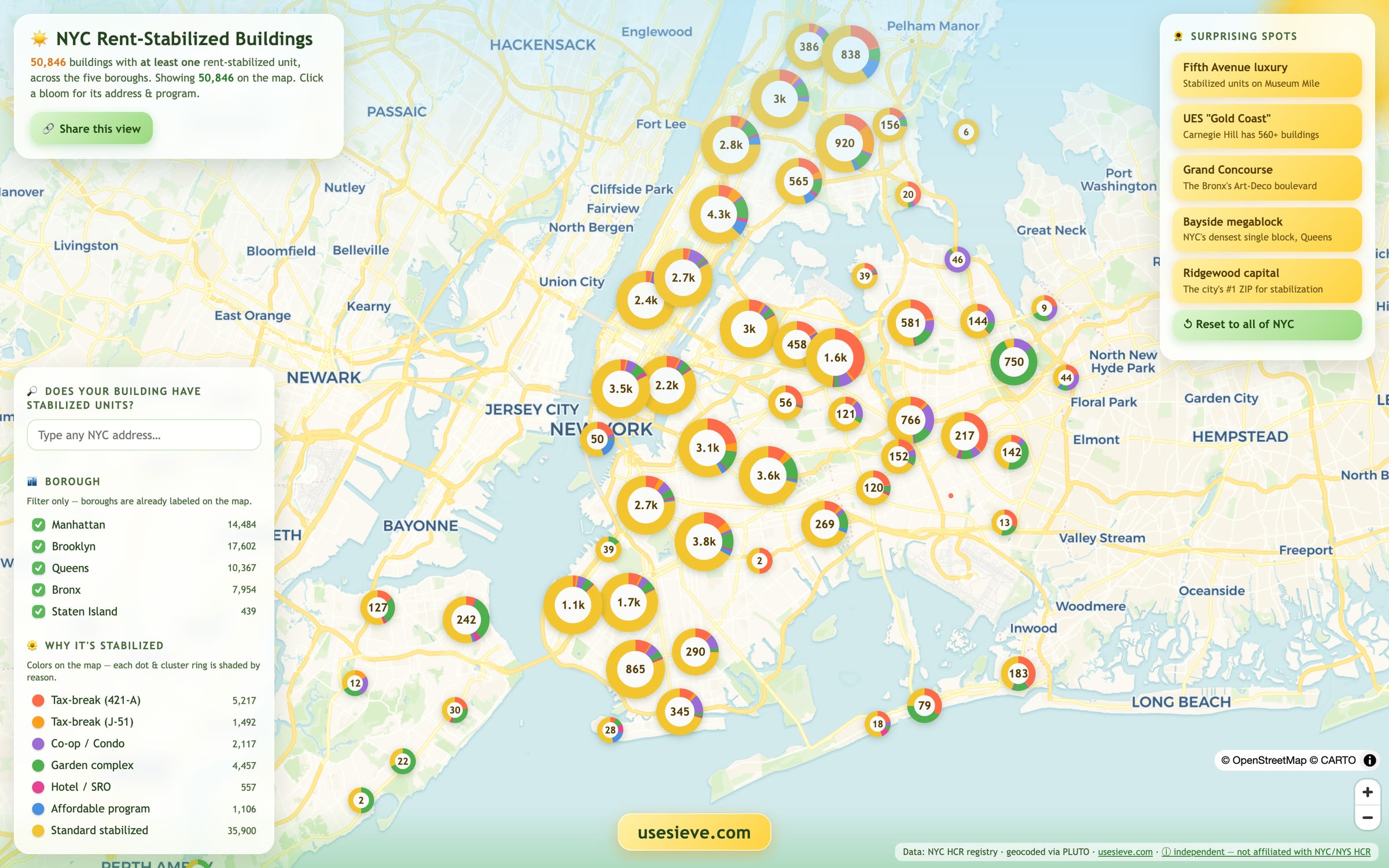
So we collected the data and built an interactive map.
You can check whether your building appears to contain rent-stabilized units in about 30 seconds.
Important caveat: this is building-level data. A building appearing on the map does not prove that your specific unit is rent stabilized. It means the building may contain rent-stabilized units, and it is worth checking.
From the app, you can also request your apartment's rent history from the city, which is the next step if you think your unit may have been misclassified or overcharged.
One thing that might surprise you: rent-stabilized apartments are not only in old walkups with suspicious radiators. Many are, yes. Roughly 70% of the buildings in the dataset are from before 1974.
Rent stabilization largely took a ~25 year hiatus, but it's back, and newer buildings can have rent stabilization too, often because of programs like 421-a, where developers received tax benefits in exchange for making units rent stabilized for some period of time.
The list includes famous buildings like Brooklyn Tower, One Manhattan Square, and 8 Spruce Street. If you live in a rent-stabilized unit there, you probably already know it, because I assume getting that apartment involved a Hunger Games-style battle to get it.
But the list also includes plenty of normal, unassuming buildings where tenants might not know to check.
It is worth looking. It takes 30 seconds, and the upside could be very real.
I am, again, not a lawyer. I just like collecting annoying public data from the internet and making it usable.
Check whether your building may contain rent-stabilized units →